

Lost in Translation: How Corporate Jargon Undermines Leadership
The Case for Clarity and Straight Talk in the Workplace Why It Matters

We were utterly confused
As I took my seat at the company’s town hall, I sincerely felt excited about the future. The room was buzzing with energy—colleagues packed into every row, eager for the latest update. Just weeks earlier, our pharmaceutical company had announced a major merger, sparking anticipation and questions across the organization.
This was no ordinary meeting.
Leaders from both companies were here to share their vision for the future.
The stakes felt high.
But as soon as the speakers began, excitement quickly turned to confusion.
“We’re thrilled to embark on this transformational journey, leveraging our synergistic frameworks to optimize cross-functional integration and unlock unprecedented value creation. By operationalizing strategic blueprints and harnessing next-gen best practices, we’ll seamlessly accelerate actionable insights, drive stakeholder alignment, and enhance value-added deliverables. Together, as a forward-thinking ecosystem of innovation, we’ll disrupt legacy paradigms, actualize scalable solutions, and capitalize on enterprise-wide synergies to redefine our market footprint and achieve holistic growth trajectories.”
Huh? 🤔
To be fair, I don’t remember his exact words.
But I do remember how I felt after that meeting: confused and uninspired.

“Jargon allows us to camouflage intellectual poverty with verbal extravagance."
– David Pratt, former Canadian politician
Why Jargon Creates Confusion Instead of Clarity
Corporate jargon is everywhere.
At its core, jargon is the use of overly complicated, technical, or buzzword-heavy language that obscures meaning instead of clarifying it.
Here’s the problem: communication should foster (is “foster” jargon? I do apologize😁) understanding, but jargon has the opposite effect. Instead of making ideas accessible, it builds barriers. Employees feel alienated when they can’t decipher what’s being said, and critical messages often get lost in translation.
"The single biggest problem in communication is the illusion that it has taken place." – George Bernard Shaw
A survey of 1,000 professionals highlighted by the World Economic Forum found “like a family” and “fast-paced environment” are the most annoying phrases in job postings. And workplace classics like “circle back” don’t fare much better— most view jargon as a turn-off.
The takeaway?
Ditch the fluff.
Say what you mean.
Clarity wins.
Decoding the Jargon: What They Say vs. What They Mean
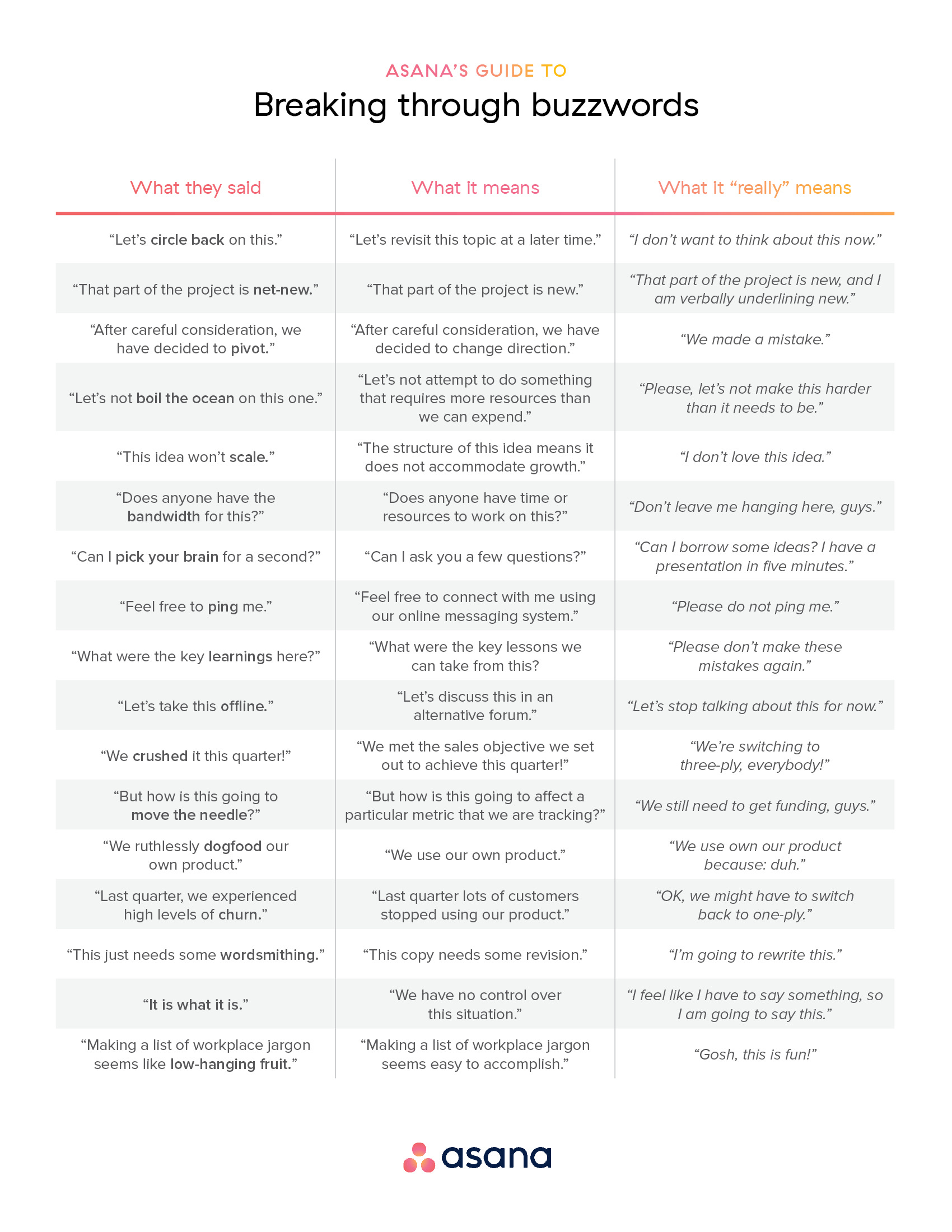
Sometimes, you can’t escape it and you need to be able to decode this strange dialect.
I found a gem: Asana’s Corporate Jargon Cheat Sheet.
It’s a perfect reminder that sometimes, the best way to communicate is to just say what you mean.
Practical Tips to Ditch the Jargon
How do we get past all the buzzwords?
Here’s a good start:
1. Say What You Mean
Keep it simple. No need for fancy words. Just say what you mean in clear terms.
2. Use Examples
Explain with real-world examples. Instead of “synergize,” say “we’ll work together to solve this problem.”
3. Make It Actionable
Focus on what people can do, not abstract concepts. “We’ll improve wait times by 30%” is way clearer than “creating value.”
4. Invite Feedback
Encourage your team to ask if something’s unclear. It helps everyone stay “on the same page” (ok, I couldn’t help myself, more jargon😁).
5. Keep It Short
Don’t drag it out. Short, clear sentences make your message stronger.
Take-Home Messages
🦉 Jargon only makes things harder.
Keep it clear, and people will get on board faster.
About the Author:
Nick is passionate about enabling people and businesses to reach their full potential. He taps into over 25+ years of truly diverse leadership experience, challenging the status quo - to ultimately define a clear strategic path forward and propel success.
Thought Leader | Board member | Founder of Aktina Group Consulting | Proud Father
Sounding smart is incompatible with creating practical understanding, especially when it comes to communicating vision and strategy. The counterintuitive reality is that people crave the 5-year-old version of an idea to grasp how to translate it to their work.
I worked in higher education, and they’re the epitome of talking in circles, leaving you thinking, ‘I don’t even know what any of that means.’